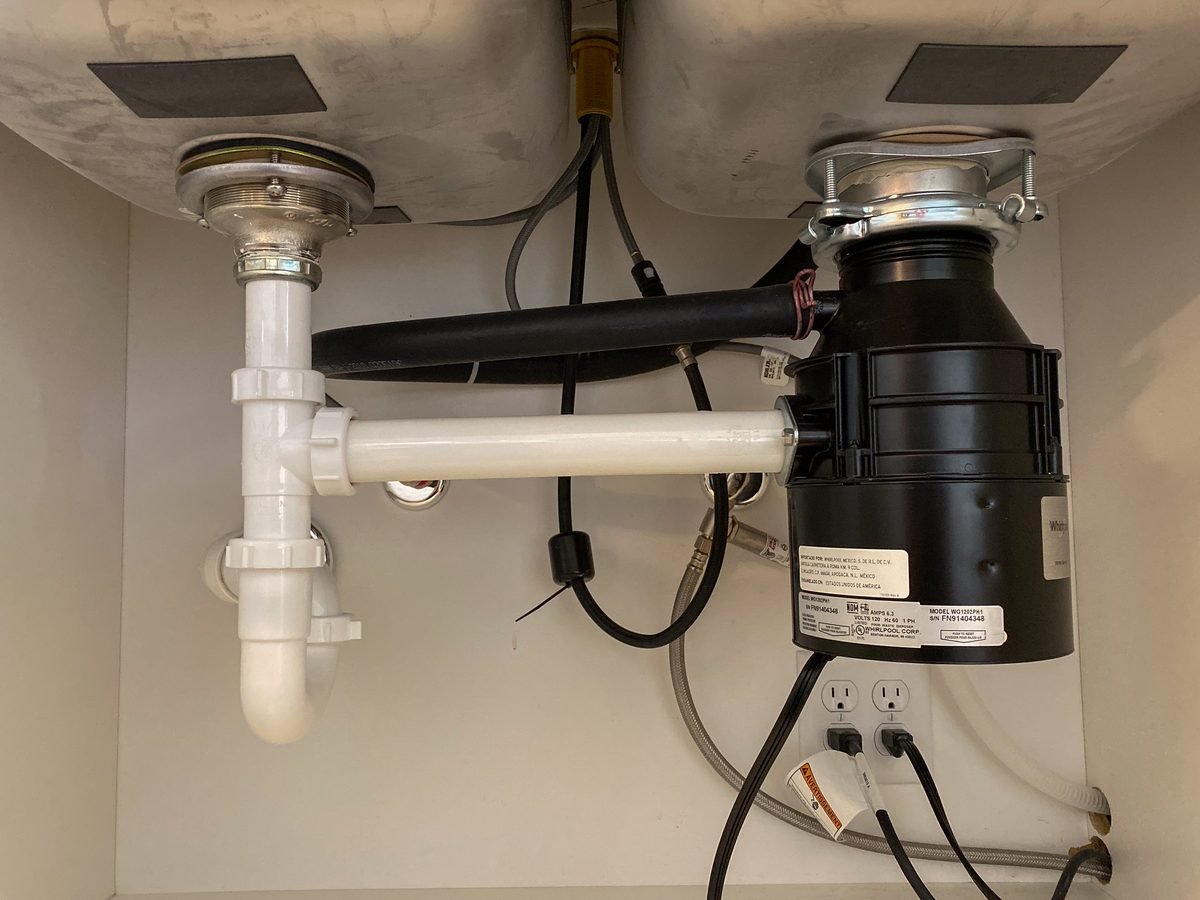
What you'll need
- ¼-inch hex key / Allen wrench (one usually came with the disposal — check the cabinet)
- Flashlight
- Long tongs or needle-nose pliers
- Bucket and towels
- Cold water (for testing)
Step-by-step
- Kill the power first. Flip the wall switch OFF. For real safety, unplug the unit under the sink or flip its breaker — you'll be working around the drain opening, and a disposal that suddenly starts is a nightmare scenario.
- Figure out which problem you have. Flip the switch briefly: a hum with no spinning means the motor works but the grinding plate is jammed. Total silence means no power is reaching it (tripped reset, tripped breaker, or dead unit).
- If it's humming: unjam it from below. Find the hex-shaped socket in the center of the unit's underside. Insert the ¼-inch hex key and work it back and forth — you'll feel the jam break free as the plate starts turning. This manually rotates the grinding plate past whatever's stuck.
- Fish out the obstruction. Shine the flashlight down the drain and pull out the culprit with tongs or pliers — usually a bone fragment, a piece of glass, or a wad of fibrous vegetable. Never reach in with your hand, even with the power off.
- Press the reset button. It's the small red (sometimes black) button on the bottom or side of the unit. The motor's overload protector trips when it jams, so it needs a reset even after you clear the blockage. Push it firmly until it clicks.
- Restore power and test with cold water. Plug it back in (or flip the breaker), run cold water full blast, then flip the switch. Cold water keeps grease solid so it flushes through instead of coating the pipes.
- If it's dead silent: check the electrical. Press the reset button first. Then check the breaker panel and any GFCI outlet the disposal is plugged into — disposals trip GFCIs more often than people expect. If the breaker trips again immediately, stop — that's an electrician's problem.
- Learn what not to feed it. Grease and oil (they solidify downstream), bones, fruit pits, fibrous stuff like celery and artichokes, coffee grounds in large amounts, and starchy foods like pasta and potato peels (they turn to paste). When in doubt, the trash can is cheaper than a new disposal.
<div class="safety"> <strong>🛑 Stop and call a pro if:</strong> <ul> <li>Water is leaking from the bottom of the unit itself — that means the internal seals failed and the disposal needs replacing, not repairing.</li> <li>The breaker trips every time the disposal runs — that's an electrical fault, and water plus electricity is not a DIY combination.</li> <li>You dropped something valuable (a ring) or something dangerous (glass, a razor blade) in and can't retrieve it safely with tongs.</li> <li>The unit is 10+ years old, rusting, and failing repeatedly — replacement (a handyman or plumber job, $200–$400 installed) beats endless resets.</li> </ul> </div>
DIY vs pro cost
| Option | Typical cost |
|---|---|
| DIY | $0 |
| Pro visit | $150–$250 (full replacement: $200–$400 installed) |
The unjam-and-reset fix costs nothing and takes five minutes. You're paying a plumber's minimum just to do the same hex-key turn you'd do yourself.
Printable checklist
- [ ] Power OFF at the switch, unplugged or breaker flipped
- [ ] Diagnosed: humming (jammed) vs silent (no power)
- [ ] Hex key worked back and forth in the bottom socket
- [ ] Obstruction removed with tongs — never by hand
- [ ] Reset button pressed until it clicks
- [ ] Breaker/GFCI checked if unit was dead
- [ ] Tested with cold water running full blast
- [ ] Know the never-grind list (grease, bones, fibers, pits)